VISIT TO CARDIFF MUSEUM
23rd May 2012
This visit was arranged following a shorter visit in 2011 on the way to Pembrokeshire (click here for report). Those who were on the earlier visit were sufficiently impressed for this second and longer visit to be arranged.
As well as seeing the main ‘Evolution of Wales’ geological exhibition ‘behind the scenes’ tours of three areas were organised. These areas were:
- Palaeontology Laboratory with Dr. Christian Baars
- Conservation Laboratory with Dr. Huw Boulton
- Palaeontology Archive with Cindy Howells (Collections Manager)
Our group was split into three to enable everyone to see the work in each of the areas.
Palaeontology Laboratory
Dr. Baars explained that the overall purpose of the lab was to:
· Prepare fossil specimens for the museum collection for display, research and teaching
· Photograph and image specimens
· Research (Independent of Cardiff University)
Preparation
Preparation is done in a number of different ways depending on the type of fossil and the rock material containing it. Ordinary manual tools (including toothbrushes!) can be used for softer materials but harder materials need things like a pneumatic preparation pen (like a miniature pneumatic drill) and micro sand blasters. Very fine abrasive powders are used down to a few micron particle sizes. The skill is in bringing out the fossil in the best possible relief. This work has to be painstaking and a single specimen can take 100s of hours spread over many weeks.
There is also a wet lab where acid etching is used to differentially dissolve surrounding material.
After preparation castings are made usually with silicone rubber. The castings have to record very fine detail and be free from bubbles so that they can subsequently be used for microscopy and even electron microscopy.
Imaging
The laboratory has an extensive imaging suite with SLR cameras and microscopes. An electron microscope is shared with Cardiff University. The Museum also has an X-Ray Diffractometer which is used to analyse the chemistry and crystal structure of minerals.
Research
Dr. Baars described one of his current research projects using specimens collected by a colleague in Iran/Iraq. This is believed to be a solitary Rugose Coral and, if confirmed, will be one of the oldest to be identified having been dated to the Lower Ordovician period (~490 MYA).
Dr Baars has used a cutting edge technique to non-destructively image the inside of the coral. Using X-Ray Synchrotron Tomography he has produced a rotatable 3-D computer image of the coral. The high power X-ray source is the national ‘Diamond Light Source’ synchrotron located at the Harwell Laboratories, Didcot, Oxfordshire.

Dr. Baars explains fossil cleaning with a preparation pin.
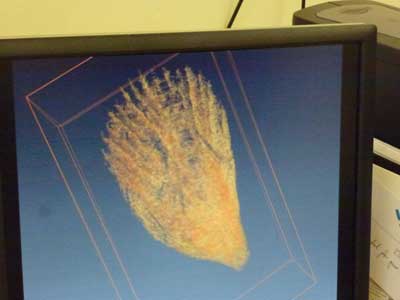
Viewing the inside of a Rugose Coral using tomography.
Conservation Laboratory
Dr Huw Boulton explained how the Conservation Laboratory served all the other museum departments (Palaeontology, Mineralogy and Geology). He described his work as fighting the 2nd Law of Thermodynamics as everything is in some form of decay!
Environmental Control
Dr. Boulton’s department has responsibility not only for repairing items but also for ensuring that all the collections are as stable as possible to minimise decay. To this end he is responsible for the temperature and humidity control of each area of the museum. Temperatures are controlled to between 20 and 23 deg C and relative humidity to between 45 and 55 %. Fluctuations in both temperature and humidity are more important that the absolute values. Lower absolute temperatures slow down chemical reactions and low humidity tends to lead to shrinkage and cracking, particularly in bone. Different specimens need different ideal environments so there always has to be a compromise.
Adhesives
The most basic and trivial conservation is keeping the dust off! However breakages occur and specimens also need to be stabilised to minimise the effects of the environment.
When choosing adhesives it is important that the action is reversible as future work may need to get back to the original state of the specimen. Hence adhesives such as Araldite cannot be used. The adhesive most in use is an acrylic known as B72 which is soluble in acetone. Weak solutions (3%) are used for priming surfaces prior to fixing or for stabilising porous material. Stronger solutions (25%) are used for actually fixing pieces together. Soaking in acetone for 24 hours completely reverses the process.
Ethics
Dr. Boulton showed an example of an unidentified dinosaur bone which had been found in the museum in about 10 pieces. He had glued it back together but due to the pieces reacting differently to the environment they did not fit well together. It would have been possible to fill in the gaps and paint it to look. However this would have made it a ‘fake’ and would have not preserved its ‘story’.
Pyrite Decay
A major problem with most specimens is that they usually contain some percentage of Iron Pyrites (Iron Sulphide or ‘Fools Gold’). When exposed to air and water a chemical reaction occurs (akin to rusting) where the Iron Sulphide reacts with oxygen to produce Iron Sulphate. This in turn combined with water to produce a series of hydrated Iron Sulphates with increasing amounts of water namely:
FeSO4.H2O
FeSO4.4H2O
FeSO4.7H2O (‘Melts’ in air)
There is a corresponding volume increase with each increase in hydration and this destroys the physical integrity of the specimen. This is particularly devastating for fossils. The sulphate ions also react with water to produce sulphuric acid which adds to the devastation.
In earlier times this process was thought to be caused by bacteria!
To stop this decay process the specimen is soaked in Ammonia water. While this is very effective the way it works is apparently not understood and we were challenged to find out more about it.
It is easy to detect Pyrite Decay by its smell which once smelt is never forgotten! Apparently the smell is detectable before any physical changes can be seen.
Even with the ammonia water treatment the specimen must be sealed in a special plastic film where it can be safe for decades.

Dr. Boulton explains the functions of the Conservation Laboratory to the group.
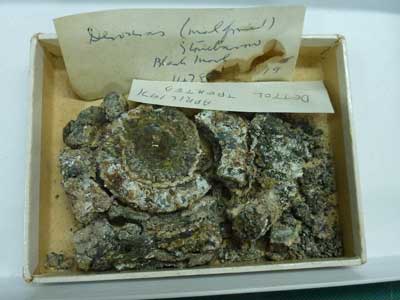
The effect of Pyrites Decay on an ammonite.
Palaeontology Store
The palaeontology store holds around 300,000 fossil specimens in its collection covering about 3000 British types. The collection is fully databased but the task of adding photographs has only just started. The project to photograph each specimen will naturally result in a full audit and the resulting database will be put on-line.
Cindy Howells had laid out a selection of specimens for us and used them to illustrate her talk outlining the geological history of South and Mid-Wales. Nearly all geological periods from the Cambrian are found in Wales
The oldest fossils in the collection are Cambrian Sea Pen ‘Holdfasts’ which were the anchor points for these coral-like animals. Also from the Cambrian we were shown examples of hard bodied animals like Trilobites and pieces of a shrimp-like Arthropod from St. Davids. Most of these specimens were fossilised in Cambrian Shale.
During the Cambrian to Ordovician period the Welsh Basin was in deep water and we saw examples of Brachiopods of exactly the same type as found in Iran and Iraq
With Plate tectonic action in the Silurian period the Welsh basin was closing and was being covered by shallower warm tropical seas. Coral reefs were common and we saw examples of Corals, Brachiopods and Trilobites. In particular Cindy showed us a beautiful example of a starfish of which the museum is particularly proud.
At the end of the Silurian period Old Red Sandstone deposits held a mixture of fish head shields and fragments of the earliest land plants. The land plants can be distinguished by the presence of airborne rather than waterborne spores. In this period fine shallow water sandstones from the Brecon Beacons show sinusoidal tracks of fish tails and crustacean tracks.
In the early Carboniferous period limestone fossils from Barry show evidence of a very stormy tropical monsoon climate. In particular corals show this as they are repeatedly knocked over flat and then re-grow upwards at 90 degrees. Crinoids also suggest this high energy environment as in South Wales they are only ever found in pieces.
In the late Carboniferous ‘Coal Forests’ are in evidence showing repeated flooding, dying and re-growing of the trees and vegetation. The collection has many leaf and tree trunk fossils in coal from times when coal was mined by hand. The advent of mechanical mining has all but stopped this fossil source.
The Permian period is absent in Wales and the next period in the collection is the Triassic. The collection has a number of Dinosaur footprints in Triassic deserts from the area of Barry. These are found in many superimposed layers. Herbivores and Quadruped fossils are also found.
In the early Jurassic some of the very earliest shrew-like mammals are found in Wales. In this period sea levels were rising again. Stretching from South Gloucestershire to Penarth there is evidence of massive and sudden storm surges. This produced inundation of the land by the sea depositing marine life and resulting in the Penarth Bone Beds. Cindy showed us a recent acquisition of beautiful Ichthyosaur skull fossil from Penarth.
This ‘high-energy’ environment also resulted in thick shelled Ammonites and Bivalves.
In the Quaternary period the collection has ‘cave bones’ of Hyenas and Woolly Rhinos from the last Ice Age. The most recent fossil is that of a Pig Bone from Newport roughly dated to 20,000 YA. It was probably originally preserved in a peat bog and to us did not look like a fossil.

Silurian Starfish.

Ichthyosaur skull from Penrith, early Jurassic.
‘Evolution of Wales’ Galleries
After lunch we did a self guided tour of the Museum’s ‘Evolution of Wales’ galleries. These are extremely well laid out and presented with a huge number of exhibits. The walk through the galleries takes one on a chronological journey from the formation of the earth to the present with the focus on Welsh geology and palaeontology.
Although we had about 2 hours for the tour it was not long enough. Any future visits should allow 3 to 4 hours.
Dick Harris